Date:
December 29, 2025
Author:
Anastasia Fainberg
/
Founder & Managing Partner
Every year, right around late December, I see the same pattern in Denver families.
You’re closing out the year. Wrapping gifts. Booking flights. Making your “start 2026 on the right foot” list. And the list is always responsible: update insurance, recheck beneficiaries, get the kids’ school forms ready, finally schedule that annual physical.
But almost no one adds the one thing that quietly controls everything else: your digital access.
Because in 2026, your estate isn’t just a house and a bank account. It’s a phone full of two-factor codes. A password manager holding your entire life. A cloud drive with tax returns, deeds, and family photos. And for more families than you might think, cryptocurrency.
If that access plan isn’t built into your estate plan, the people you love can have legal authority… and still be locked out.
This article will walk you through what digital estate planning really means in Colorado, where the law helps, where it stops, and how to protect both online money and irreplaceable memories as you head into 2026.
Why Colorado estate planning needs a digital update in 2026
Colorado families are managing more wealth and more responsibility through logins than ever before.
According to the US Census Bureau, Denver’s median household income is about $91,681 (2019–2023). That’s not a brag, that’s a reality check, because higher income usually means:
- More accounts.
- More apps.
- More stored financial records.
- More automatic payments.
- More digital “stuff” your family will need to find fast.
And the number of passwords alone should make you pause.
A 2024 NordPass survey found the average person has about 168 personal passwords and 87 work passwords, over 250 total. That means your “estate” isn’t one folder anymore.
It’s a maze.
Pro Tip: If you’re Googling Denver will attorney at midnight while making your January goals, it’s time to look for guidance on how digital property intersects with Colorado probate.
Case Study: David
David was a Denver software designer. Organized, responsible, the kind of person who used a password manager because he took security seriously. His vault held everything:
- Banking logins.
- Tax documents.
- Client contracts.
- Family photos.
- And a crypto wallet.
When he died unexpectedly, his spouse did what most people assume will work: she gathered documents, and since she had authority to handle the estate, she tried to access the accounts.
But she didn’t have the password manager master key. So she was stuck in a painful loop:
- The accounts required two-factor authentication.
- The codes went to the locked phone.
- The phone required the vault.
- The vault required the master key.
It wasn’t “hidden”, it wasn’t suspicious. It was just incomplete planning for a very modern life.
How a Denver Estate Planning Attorney uses Colorado digital-asset law (and where it stops)
Colorado has adopted the Revised Uniform Fiduciary Access to Digital Assets Act, often called RUFADAA.
In plain English, this law can help your fiduciary (your agent under a power of attorney, your personal representative after death, your trustee) request certain access from “custodians” like online providers. Colorado’s version lives in Title 15, Article 1, Part 15 (§§ 15-1-1501 through 15-1-1518).
That’s the legal side. But here’s the practical side I want families to understand before 2026 gets busy:
- Legal authority does not magically produce passwords.
- A court order doesn’t bypass multi-factor authentication.
- A statute can’t recreate a missing recovery phrase.
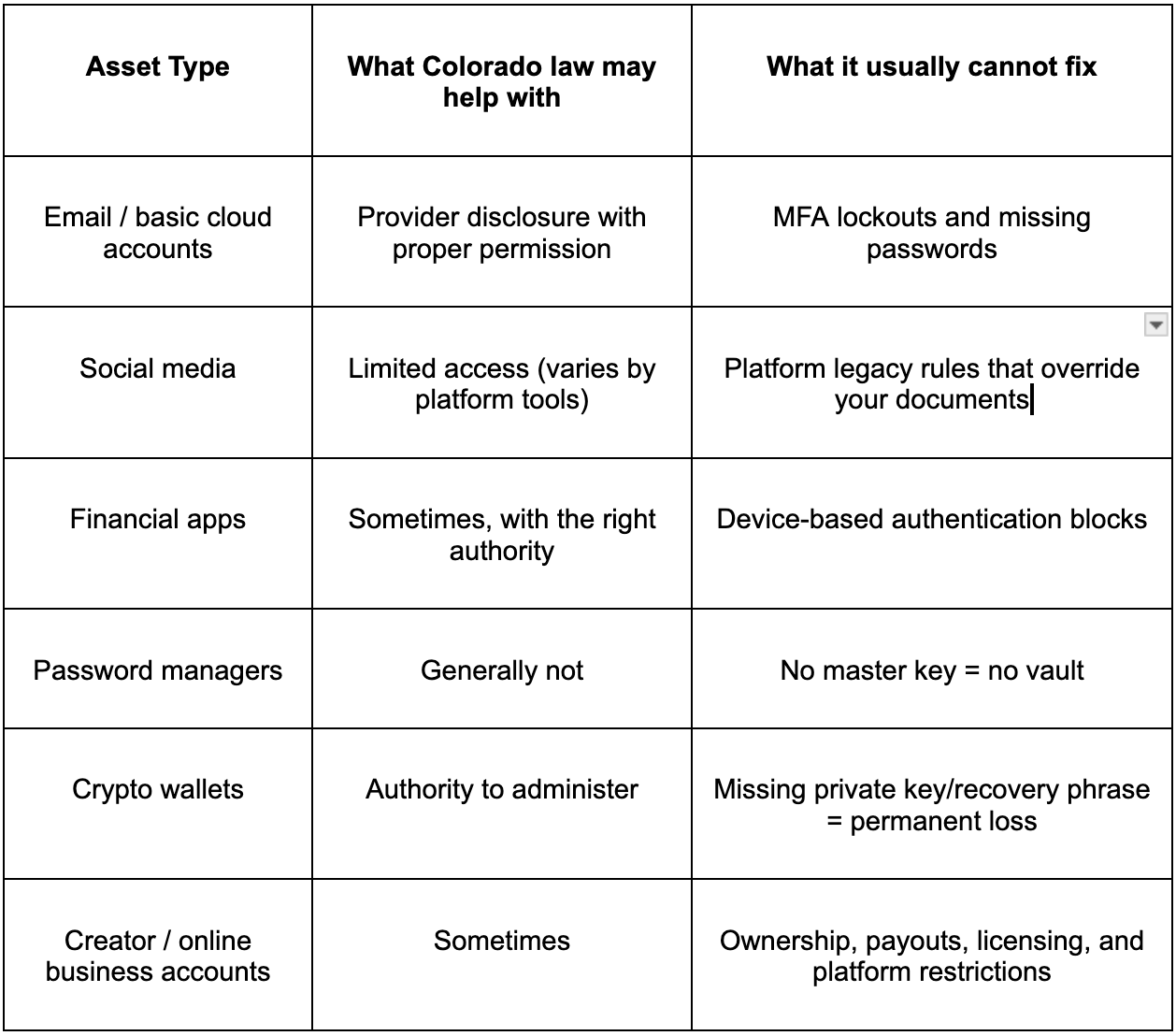
RUFADAA helps with permission and process. It does not guarantee access when technology is the real gatekeeper.
Side-by-side: Traditional digital access vs. modern digital wealth (2026 reality)
Emotional Reflection: the risk nobody puts on the checklist
Not all digital loss is financial. Sometimes the worst part is losing the things that can’t be replaced:
- Voice messages from a parent.
- Videos of your kids when they were little.
- A shared photo album.
- Private notes and letters saved in an email draft.
The grief is hard enough. It gets heavier when families can’t retrieve the digital pieces of someone’s life because no one planned for access.
Legal Analysis - key concepts and what they mean for Colorado families
RUFADAA: A Colorado framework that can support fiduciary requests to providers, but it won’t hand your family your passwords.
Fiduciary: The person you legally appoint to act for you, and in 2026, they can still be blocked by technology if there’s no access plan.
Multi-factor authentication (MFA): The “prove it’s you” step that can stop a spouse or adult child if the verification goes to a locked device.
Password manager: A tool that often becomes the single point of access to everything, so it needs “succession planning,” not just good security.
Private key / recovery phrase: The code that controls many crypto wallets; if it’s missing, courts and companies typically can’t restore it.
The Reality / Takeaway - 2026 is the year families feel this more
Cybercrime and account-based scams aren’t slowing down. The FBI’s Internet Crime Complaint Center reported about 859,532 complaints in 2024 and reported losses of $16.6 billion… up 33% from 2023.
And older adults were hit especially hard: victims 60+ reported $4.8 billion in losses in 2024.
Why does that matter for estate planning? Because many of these crimes, and many estate headaches, start the same way: a compromised login… a locked device… a confused family trying to prove authority in the middle of stress.
This is often the point where families learn, too late, that without proper planning, the only option left may be court intervention, sometimes through guardianship, a situation an estate planning attorney is meant to help families avoid.
Default law vs. custom planning
- Default: “My spouse will handle it.”
- Custom: “My spouse has authority and a clear path to access.”
- Court-driven outcome: delays, forms, provider requests, and device lockouts.
- Family-driven outcome: fewer surprises, faster clarity, and less digital chaos during grief.
Common Misconceptions (Myths)
Myth #1: “My spouse can just reset the password.”
In 2026, many “resets” still require MFA sent to the device or email you’re locked out of. If the phone is inaccessible, the reset can be a dead end.
Myth #2: “My executor can get in with a court order.”
Court orders can help with disclosure in some situations. However, they don’t unlock password vaults, bypass MFA, or recreate missing crypto keys.
Myth #3: “I don’t have crypto, so this isn’t me.”
Crypto is more common than many families realize. Pew Research found 17% of U.S. adults say they’ve ever invested in, traded, or used cryptocurrency. Gallup reported 14% of U.S. adults own cryptocurrency.
Myth #4: “My will already covers this.”
A will names people. It doesn’t solve access. Digital planning is where legal authority and real-world logistics have to meet.
Myth #5: “This is only for tech people.”
If you have a phone, a bank app, a cloud photo library, or subscriptions on autopay, you have digital assets.
Why This Really Matters
At the end of 2025, a lot of families are thinking about fresh starts. New year. New routines. Less clutter.
This is one of those “quiet adulting” moves that protects your family in a way they may never see, until they need it. Because your plan shouldn’t fall apart over a login screen. As I often tell families, it’s not about money. It’s about the people you love.
How to Start - simple steps to carry into 2026
- Make a basic inventory of your most important accounts (financial, cloud storage, business, subscriptions). Separate what is sentimental (photos, videos, messages) from what is financial (banking, crypto, payroll, tax portals).
- Turn on platform legacy tools where available (and don’t assume one setting covers everything).
- Create a secure emergency-access plan for your password manager that aligns with your legal plan.
- Bring this into your estate planning review so your fiduciary has both authority and direction.
- If you’re already the kind of person who searches estate planning attorney near me every January and then forgets by February, make this the year you actually handle it.
- And if you want ongoing support, this is exactly why we built our Client Care Program and our LIFT approach (Legal, Insurance, Financial, Tax): your plan should keep up with your life, including your digital life.
FAQs - Digital Assets in Estate Planning
1) Does Colorado probate automatically unlock online accounts?
No. Probate can establish authority, but providers and devices often require separate processes, and access may still be limited by technology.
2) What is RUFADAA in Colorado?
It’s Colorado’s version of the Revised Uniform Fiduciary Access to Digital Assets Act, located in Title 15 (§§ 15-1-1501 to 15-1-1518).
3) If I have a trust, does that solve digital access?
A trust can reduce probate, but it doesn’t automatically solve device locks, MFA, or password manager access. It’s one layer, not the whole solution. A trust attorney can help with this.
4) Do I need to give my family all my passwords?
Not as a blanket rule. The goal is controlled access, not scattered passwords. The right approach depends on your family dynamics, security concerns, and what assets you hold.
5) What happens to cryptocurrency if no one has the recovery phrase?
In many cases, it may be unrecoverable. That’s why crypto requires planning that includes both legal authority and secure documentation practices.
6) What about online business income (Stripe, PayPal, Etsy, creator accounts)?
Funds can be held, admin access can be blocked, and ownership/payout rules can vary by platform. Business owners often need a specific succession plan for these accounts.
7) Is this only a “death planning” issue?
No. Incapacity planning matters too. If you’re hospitalized and can’t access your accounts, your agent may need both legal authority and practical access.
8) How often should we review digital planning?
At least annually, and anytime you change phones, switch password managers, add a crypto wallet, start a business, or add a new income stream.
Closing Reflection
If you’re making resolutions for 2026, add one that protects the people you love: make sure your digital life can actually be found, accessed, and handled when it matters.
Don’t leave your family’s future to chance. Schedule your consultation with Legacy Law Group Colorado today and take the first step toward peace of mind.