


Date:
December 29, 2025
Author:
Anastasia Fainberg
/
Founder & Managing Partner
Every January, Denver parents get the same quiet reminder from schools and activities: update your emergency contacts, sign the permission slips, list who’s allowed to pick your child up if you can’t be reached…
Most of us fill that out without thinking twice. Because of course there’s someone: a sister in Highlands Ranch, a neighbor in Wash Park, a grandparent in Lakewood. We assume the “backup plan” is obvious.
But Colorado law doesn’t run on the same kind of permission slip. If you and your co-parent aren’t able to speak for your child, the people you trust may not have legal authority when it matters most.
In this article, I’m going to explain why that gap exists, what “short-term” and “long-term” guardianship really mean in Colorado, and what a calm, protective plan can look like as you start 2026 with more certainty. According to the U.S. Census Bureau’s QuickFacts for Denver, 18.3% of Denver residents are under 18, which is why this isn’t a niche concern, it’s everyday family planning.
Why This Problem Exists and Why It Matters in Colorado Estate Planning
Colorado courts can’t rely on “everyone knows what we’d want.” They have to rely on legal authority.
Here’s what I see over and over with Denver families.
A loving family is not the same thing as legal permission. A will can name a guardian, but it doesn’t cover the first 24 hours. Schools and doctors need documentation, not good intentions. Blended families add layers the court can’t guess correctly. If there’s conflict, the court process slows down at the worst possible time.
Pro Tip: If you’re Googling Denver will attorney because you’re worried about guardianship, you’re asking the right question, just make sure your plan covers both the “right now” moment and the “long-term” plan.
The First 72 Hours Matter: What a Trust and Estate Attorney Plans for Beyond the Will
Maya and Chris live in Denver. Two kids. Busy schedules. A normal, full life.
They had talked about guardianship casually for years. “My sister would take them.” “Your parents would help.” It felt obvious.
Then an unexpected emergency happened while they were traveling out of state. Not a dramatic movie moment, just one of those real-life situations where two adults are suddenly unavailable at the same time.
Because there was no temporary guardian authorization on paper, the people who loved those kids couldn’t immediately step in the way they assumed they could. For a short window, the county had to make a safety decision first, before the “family preference” could be sorted out.
That’s the guardianship gap. It’s not about whether your family is good. It’s about whether your plan is usable when time is tight.
Wills vs. Trust Planning for Kids in 2026: When to Create a Will and When a Trust Matters
Most parents start with a will because it feels like the “main document.” And a will matters. But when we’re talking about kids, a will is often only one layer of what your family needs.
Here’s a simple side-by-side I walk families through as a estate planning attorney.
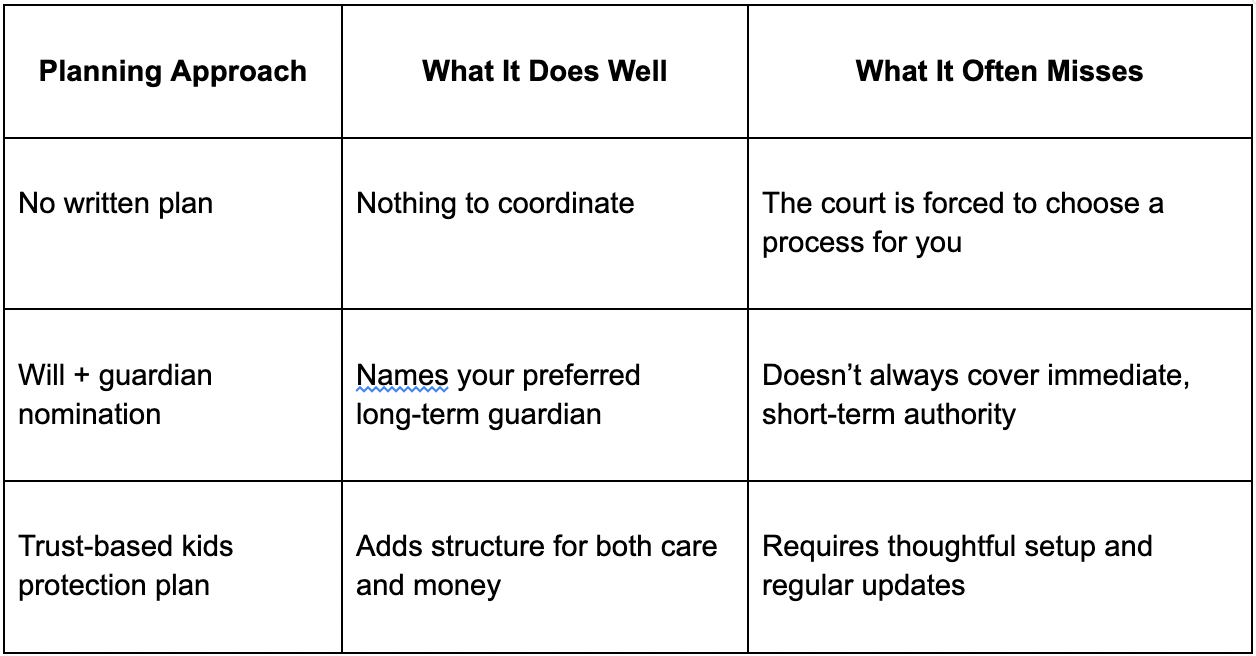
A will can tell the court who you want as guardian. It can’t always hand someone the legal ability to pick up your child from school tomorrow.
A trust can do something different. It can help control how money is held and used for your child, so your guardian isn’t personally funding everything, and your child doesn’t inherit in a single, unprotected transfer at adulthood.
And for small business owners, this matters even more. If your income, your real estate, or your company ownership is part of your child’s support system, a trust-based approach can create stability when life gets disrupted. The Federal Reserve Bank of St. Louis (FRED), using U.S. Census Bureau homeownership data, puts Colorado’s homeownership rate at 65.7%, which means for many families, the home is part of what you’re trying to keep stable for your kids.
The Part Parents Don’t Say Out Loud
Most parents don’t avoid guardianship planning because they don’t care. They avoid it because it’s emotionally heavy. I’m a mom too. I understand the instinct to say, “We’ll handle it later,” because thinking about it makes your chest tighten.
But what I’ve learned, both personally and professionally, is this: the cost of uncertainty lands on the people you love. And in Colorado, uncertainty often turns into a court process, right when your family needs privacy, simplicity, and clear direction.
Guardianship + Money: How a Wills and Trusts Attorney Builds a Two-Layer Plan
Temporary guardianship authorization: A document that gives a trusted adult short-term authority to care for your child. Without it, schools, doctors, and institutions may have to wait for court direction before recognizing someone’s authority.
Guardian nomination in a will: Your written statement of who you want raising your child long-term. Without it, the court must decide based on the evidence presented, which can create delay and conflict if relatives disagree.
Best interests of the child: The legal standard the court must follow in Colorado. If your family has competing opinions, the court’s job is to evaluate, not to assume your preference.
Kinship care: Placement with relatives or close family friends when parents can’t provide care. Without clear documents, “kinship” may still require verification and process before it becomes stable.
Kids Protection Trust: A trust structure designed to hold and manage resources for a child’s benefit. Without trust planning, money intended for your child can end up in court-supervised management and released on a rigid timeline.
The Reality: Colorado’s Default Process vs. Your Family’s Plan
If parents don’t build a plan, Colorado still has to protect the child. That’s the legal bottom line. But there’s a difference between the state’s default process and a family-driven plan.
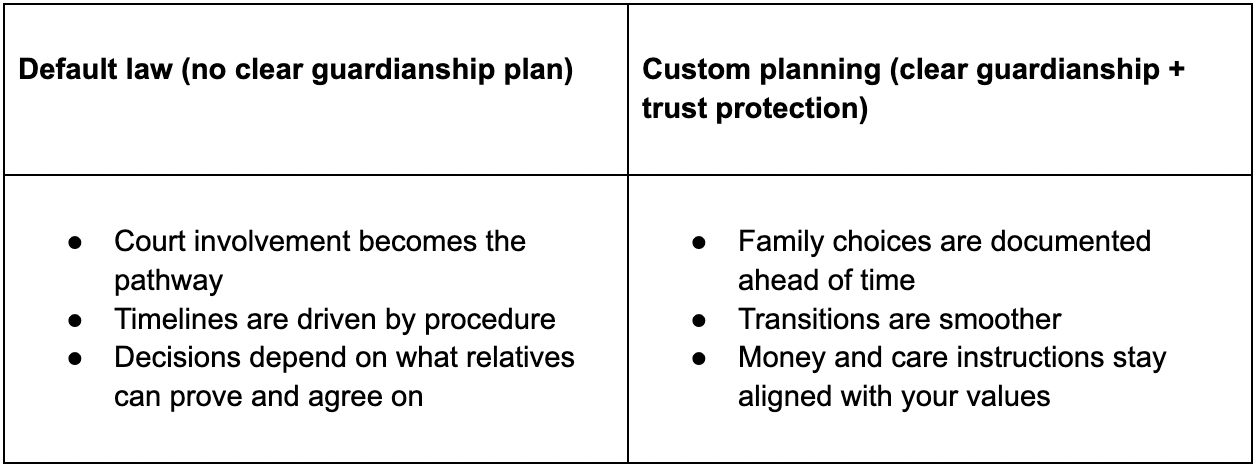
This is why I encourage parents to think about guardianship as a “two-part plan.” Who steps in immediately. And who raises your child long-term.
Common Misconceptions
Myth #1: “My sister will get the kids.”
Maybe. But without paperwork, your sister may still have to wait for legal authority to be recognized, especially for medical care, school access, or travel decisions.
Myth #2: “Everyone knows what we want.”
Families often “know”… until stress, grief, or logistics hit. Colorado courts can’t base decisions on family stories, they need written direction that holds up under pressure.
Myth #3: “A will is enough.”
A will is important, but it usually covers long-term nomination, not the immediate gap. Most parents need both a guardian nomination and short-term authorization documents.
Myth #4: “We’ll do it later.”
Later feels safer emotionally. But planning works best when you’re calm, healthy, and thinking clearly, exactly what the beginning of 2026 is for.
Myth #5: “Guardianship is just about who raises them.”
It’s also about money, stability, and instructions. Your guardian needs support, structure, and clarity, not just a title.
Why This Really Matters
The heart of guardianship planning isn’t legal theory. It’s dignity.
It’s your child staying with familiar people. It’s your child’s routines staying intact as much as possible. It’s your family having a clear map when emotions are already high.
And it’s your voice staying present in the decisions that matter most, because you took the time to document it while things were calm.
As I often tell families, it’s not about money. It’s about the people you love.
How to Start
Pick one weekend in early 2026 and do the first, simple steps.
- Choose your short-term guardians and write down why you trust them - Think “who can say yes to school pickup and doctor visits immediately.”
- Choose your long-term guardians and confirm they’re willing - A loving plan includes a real conversation.
- Write care instructions that reflect your child’s real life - Routines, medical needs, school preferences, family relationships.
- Review your assets and beneficiary designations - Your guardianship plan and your financial plan should match.
- Consider setting up a trust strategy for your children’s inheritance - This is where protection and stability live.
- Schedule a planning session with an estate planning lawyer who can tailor the documents to your family - At Legacy Law, this is often part of a Kids Protection Planning Session, and it connects naturally to our Client Care Program and LIFT approach so your plan stays current as your life changes.
FAQs
Do Colorado courts always follow the guardian I name in my will?
Courts give weight to a parent’s nomination, but they still must evaluate what’s in the child’s best interests. If there’s conflict or concerns about suitability, the process can become more involved.
What’s the difference between short-term and long-term guardianship planning?
Short-term planning helps cover the immediate gap, school, medical care, day-to-day authority. Long-term planning focuses on who will raise your child if you’re gone.
What happens if relatives disagree about who should raise the kids?
In Colorado, disputes can trigger court hearings and delay. This is one reason clear documents and consistent planning matter, because they reduce ambiguity.
Does a trust replace a guardian?
No. A guardian raises the child. A trust manages money for the child. Together, they create a more stable plan.
If my child inherits money through a will, is it protected?
Often, minor children can’t directly control inherited funds, which can lead to court-supervised management. A trust can offer more privacy, structure, and control.
How does guardianship planning work for blended families?
Blended-family dynamics can be complicated, especially when there are multiple households and strong opinions. Clear nominations, written instructions, and trust planning can reduce misunderstandings and help the court see your intent.
What if I’m a small business owner, does this affect my kids’ protection plan?
Yes. If your income or business ownership supports your family, you may also need succession planning so the business doesn’t stall during a crisis. A trust-based approach can help coordinate continuity.
Do I need to update guardianship documents as my kids get older?
Usually, yes. Relationships, locations, and your child’s needs can change. This is why ongoing review, through a program like Client Care, can be so valuable.
Closing Reflection
A good plan doesn’t make you pessimistic. It makes you prepared.
If 2026 is the year you want more stability, more clarity, more peace of mind… guardianship planning is one of the most loving places to start, because it protects your children in the moments when they would need you most.
Don’t leave your family’s future to chance. Schedule your consultation with Legacy Law Group Colorado today and take the first step toward peace of mind.