


Date:
December 29, 2025
Author:
Anastasia Fainberg
/
Founder & Managing Partner
January has a way of making Denver families want a clean slate. You’re back in routines. You’re reviewing budgets. You’re trying to get your home, your calendar, and your life “organized” again.
And then life does what it does. Someone dies. And someone else assumes everything will be fine… because “we have a will.”
What most families don’t realize is this: in Colorado, probate isn’t just paperwork.
It’s a court process with built-in waiting periods. And those waiting periods don’t bend around grief, schedules, or urgent family needs.
In this article, I’m going to explain why probate can take months in Colorado, what causes the most common delays, and what a clear plan looks like when your goal is to keep your family moving forward with privacy and stability.
Why Probate Takes So Long in Colorado: What a Probate and Estate Attorney Sees Over and Over
Probate exists to transfer legal ownership after death. But in Colorado, the court process has “built-in pauses” that often surprise families.
- Probate has timelines, even when everyone agrees.
- Probate often requires formal notices before anything can move.
- Probate can trigger extra steps when accounts are missing beneficiaries.
- Probate can slow down when a home needs to be sold or retitled.
- Probate can stall when paperwork doesn’t match real life.
Pro Tip: If you’re searching for a will attorney, you’re usually not looking for a document. You’re looking for a plan that prevents your family from getting stuck in court. January is a great time to get moving.
Case Study: Megan
Megan lives in Littleton and is raising two kids while helping her mom after her dad’s death. Her parents had what most Colorado families would call a “simple” situation: a home with a mortgage, retirement accounts, and a will.
But probate still stretched out, because the delays weren’t about family conflict.
A beneficiary designation hadn’t been updated after an old job change. A small life insurance policy still named “the estate” as the beneficiary. And once the case was opened, creditor notice timelines had to run before distributions could safely happen.
No one was fighting.
But Megan still spent months chasing paperwork, waiting on deadlines, and trying to keep the home stable while the court process moved at its own pace.
The 5 Places Colorado Probate Commonly Slows Down (and What Families Can Do About It)
When families tell me, “We just didn’t expect it to take this long,” it’s usually because one of these five bottlenecks showed up.
1) Waiting periods that are built into the process
Probate isn’t designed to move fast. It’s designed to be procedurally correct.
2) Creditor notice and claim timelines
Even if your loved one had no “known debts,” the process still has steps that protect valid claims.
3) The inventory and documentation phase
The court expects a clear picture of what existed, what it was worth, and who controls it now.
4) Beneficiary designations that don’t match the plan
This is one of the most common reasons “simple” estates become complicated.
5) Real estate logistics for Denver homeowners
A home creates practical pressure, mortgage payments, insurance, taxes, repairs, and decisions about whether someone can stay, refinance, or sell.
When a trust is properly funded, families often handle administration more privately and with fewer court pauses. That doesn’t mean “no work.” It means fewer court-controlled bottlenecks.
The Part Families Don’t Expect
As a mom, I understand the instinct to “handle the important stuff later.” January feels like permission to postpone hard conversations.
But probate doesn’t care about your family’s emotional bandwidth.
What I see, again and again, is that probate becomes a second job for the person who is already carrying everything else. The paperwork is manageable. The uncertainty is what takes the toll.
And in Colorado families, especially blended families, caregivers, and small business owners, that uncertainty can quietly create tension where there didn’t used to be any.
Key Concepts Denver Families Need in Plain English
Creditor notice - means the estate must follow a process that gives valid creditors a fair chance to come forward, which can delay distributions even when things feel “obvious” to the family.
Inventory - means the estate must identify what exists and what it’s worth, and missing paperwork can create weeks of back-and-forth.
Personal representative - means one person becomes the legal project manager, responsible for deadlines, documents, and protecting the estate from mistakes.
Beneficiary designations - mean some assets follow a form, not your will, and outdated designations can pull assets into probate or send them somewhere you didn’t intend.
Informal vs. formal probate - means some cases are smoother than others, but “informal” still involves rules, steps, and timing that families can’t skip.
The Reality: A Denver Estate Planning Attorney Can Help You Avoid the Default
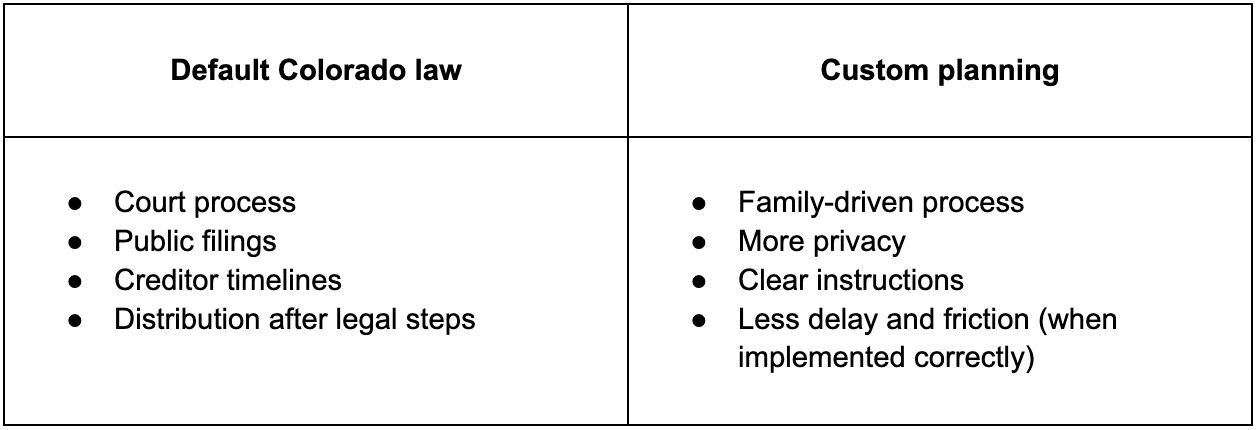
If you don’t create a plan that matches how your assets are titled and how your accounts are set up, Colorado’s default system steps in. That system isn’t “bad.” It’s just not personal. And it isn’t designed around your family’s rhythms, grief, or privacy.
For Denver homeowners, this matters because housing is often the biggest asset. In November 2025, the median listing price in the Denver–Aurora–Lakewood metro area was about $579,000, based on data published in FRED (Federal Reserve Bank of St. Louis).
When a home is involved, probate isn’t theoretical.
It touches mortgage payments, property taxes, repairs, insurance, and whether someone can keep living there without disruption.
Common Misconceptions
Myth #1: Probate will be done in a few weeks.
In Colorado, probate often includes timelines that must run before the estate can safely distribute assets. Even cooperative families can feel stuck simply because the process is structured that way.
Myth #2: Wills avoid probate.
A will is usually a ticket into probate, not a way around it. A will gives instructions, but the probate court is still the system that carries them out.
Myth #3: Probate is cheaper than trusts.
Sometimes probate looks cheaper upfront because the cost is delayed. But cost isn’t just dollars. It’s time, privacy, administrative burden, and how quickly your family can move forward.
Myth #4: We don’t have enough assets to worry.
If you own a home, have retirement accounts, or have a life insurance policy, you have enough “moving parts” for probate mistakes to matter.
Myth #5: My spouse can automatically handle everything.
Some assets pass easily to a spouse. Others don’t, especially if beneficiary forms, titles, or prior family relationships complicate the picture.
Myth #6: A small estate affidavit can handle everything.
Colorado has a small estate affidavit option for limited situations, but it doesn’t transfer real estate, and the dollar threshold changes by year.
Why This Really Matters
Probate is a burden you can lift from the family you love. Not because your family can’t handle hard things, but because they shouldn’t have to handle avoidable hard things while they’re grieving.
When families tell me, “We just want it to be simple,” what they usually mean is:
- We want privacy.
- We want clarity.
- We want fewer delays.
- We want fewer opportunities for misunderstandings.
And we want to know that the plan we created is the plan that will actually work in real life. As I often tell families, it’s not about money. It’s about the people you love.
How to Start in January: A Clear Checklist from an Estate Planning Attorney
- Make a list of your assets and how they’re titled (home, accounts, business interests).
- Confirm your home title matches your plan (especially after a refinancing, marriage, divorce, or LLC changes).
- Identify what would go through probate versus what passes by beneficiary designation.
- Review beneficiary designations and update anything that doesn’t match your intent.
- If you have a will, confirm whether it’s paired with a trust strategy, or whether it would send your family through probate.
- If you already have a trust, confirm it’s actually funded and aligned with your current assets.
- Schedule a Probate Risk Assessment with a probate and estate attorney so you’re not guessing.
And then keep it updated through a long-term plan… this is exactly why we built our Client Care Program and our LIFT approach (Legal, Insurance, Financial, and Tax).
FAQs: What Families Ask When They Search for Estate Planning Attorneys
How long does probate take in Colorado?
Many Colorado probate cases take months, even when they’re “informal.” Timelines vary based on creditor notice periods, asset complexity, and whether there are disputes.
What’s the difference between informal and formal probate?
Informal probate is less court-supervised day-to-day. Formal probate involves more court involvement and is more likely when something is contested or unclear.
Does a trust completely avoid probate?
A properly funded trust can avoid probate for the assets inside the trust. But anything left outside the trust may still require probate, which is why funding and maintenance matter.
If I have a will, do I still need a trust?
Not always. But if your goal is privacy, smoother transfer of a home, and fewer court steps, a trust is often the more protective option. This is a common conversation with families searching how to set up a trust in Colorado.
What does a personal representative actually do?
They gather assets, manage notices, handle claims, file required paperwork, and distribute what remains. It’s a significant role, and in Denver families it often falls on the person who already carries the most responsibility.
What if we own property in another state?
Out-of-state property can trigger extra legal steps. That can mean an additional probate process in that state, depending on how the property is titled and what planning was done.
Can probate be avoided for a home in Colorado?
Sometimes, depending on how the home is titled and whether a trust or other planning tool is used. This is one reason Denver homeowners often look for a trust attorney before they make changes to the deed.
Do beneficiary designations really matter that much?
Yes. For retirement accounts and many financial accounts, beneficiary forms often control, regardless of what the will says.
How much does probate cost in Colorado?
It depends on complexity, professional support needed, and how organized the estate is. In my experience, the “cost” families feel most is time, stress, and uncertainty, not just fees.
Is this something I can DIY?
You can find forms online, but probate and planning mistakes are often discovered only when it’s too late to fix them easily. A qualified estate planning lawyer can help you build a plan that works with Colorado law and your real-life family dynamics.
Closing Reflection
If January is your season for getting life in order, this is one of the most meaningful places to start… because it’s not just organization, it’s protection.
Don’t leave your family’s future to chance. Schedule your consultation wit