Date:
November 15, 2026
Author:
/
Summary and contents
Starting January 1, 2026, a person may qualify for an ABLE account if their blindness or qualifying disability began before their 46th birthday and they meet the applicable benefits or disability certification requirements. An ABLE account can help pay eligible expenses, while a properly drafted special needs trust can manage larger family gifts or an inheritance under trustee supervision.
- Who qualifies for a Colorado ABLE account in 2026?
- What can the account pay for, and how much can go in?
- How do withdrawals and account balances affect SSI?
- When does a special needs trust still make sense?
- How to put the account and trust on the same plan
- Comparison at a glance
- Visual guide
- Related video
- Frequently asked questions
- Can I open an account if I am older than 46?
- Is the $20,000 limit per contributor?
- Will an ABLE account replace a special needs trust?
- Sources and next steps
If you were told that you missed the window to open an ABLE account because your disability began after age 25, it’s time to check again. Starting January 1, 2026, the federal eligibility window widened. For Colorado families, that can mean another way to pay for disability expenses while keeping longer-term support organized.
Who qualifies for a Colorado ABLE account in 2026?
The age rule looks at when the qualifying disability began, not your age when you apply. A 54-year-old whose qualifying disability began at 40 may now meet the age test. A person whose condition first met the eligibility standard at 46 does not meet it on that basis. If the diagnosis came later than the onset, gather records that support when the qualifying condition began and confirm what the plan needs.
Colorado ABLE’s eligibility guide describes two main routes: entitlement to qualifying Social Security disability benefits, or disability certification with a physician-signed diagnosis and applicable severity and duration criteria. You don’t necessarily need to receive Supplemental Security Income (SSI) or Social Security Disability Insurance (SSDI) to qualify by certification. Keep the supporting records where you can find them.
What can the account pay for, and how much can go in?
ABLE stands for Achieving a Better Life Experience. It is a tax-advantaged account the person with the disability owns, even when someone with signature authority helps manage it. Qualified disability expenses can include housing, transportation, assistive technology, education, and personal support. The expense should relate to the disability and support health, independence, or quality of life. Keep the amount, date, purpose, and receipt for each withdrawal.
The IRS lists $20,000 as the general 2026 annual contribution limit. That is the combined limit for ordinary contributions to the account, not a separate allowance for each relative. If family members have already put in $12,000, another $10,000 gift would exceed the baseline. Some working account owners can contribute more under separate employment rules. Ask the program to confirm available room before a large deposit or a 529 rollover.
How do withdrawals and account balances affect SSI?
Under Social Security’s ABLE policy, up to $100,000 in an ABLE account is excluded from SSI countable resources. The excess can count along with other resources. If the ABLE excess is what puts an otherwise eligible person over the SSI limit, cash SSI can be suspended under a special rule; SSA distinguishes this from ineligibility driven by other resources. Verify Medicaid and other program consequences with a benefits adviser rather than assuming every program uses the same test.
Housing is a qualified disability expense, but timing matters for SSI. If you withdraw money for rent in November and it remains unspent into December, SSA can count the remaining money as a December resource. Plan the withdrawal and payment for the same calendar month when possible, and keep proof of when each happened.
When does a special needs trust still make sense?
A special needs trust can receive and manage a larger inheritance or life insurance payment over time. The trustee follows the trust’s terms and checks how payments interact with the beneficiary’s benefits. An ABLE account can make it easier for the beneficiary to manage some day-to-day expenses. Those are different jobs. An ABLE annual limit may make it a poor destination for a large lump sum.
If the trust permits it, a trustee may be able to transfer funds directly to the beneficiary’s ABLE account. SSA guidance excludes qualifying trust-to-ABLE transfers from SSI income, but the account’s contribution room, trust terms, and other benefit rules still matter. A trustee should get advice before transferring money. For larger gifts, review the naming instructions in Legacy’s Colorado special-needs inheritance guide.
How to put the account and trust on the same plan
- Confirm onset, eligibility records, and which benefit programs the person uses.
- Decide who will track contributions and receipts. Set a clear process for a trustee who may contribute.
- Review beneficiary forms and how larger gifts are intended to pass. Ask the trustee and benefits adviser to confirm the plan before accepting money.
- Check what happens at death or after a move. The Colorado ABLE disclosure explains Colorado’s general restriction on state claims against a deceased Colorado ABLE owner’s account, with an exception if a claim is required to maintain program qualification. Ask about services received in another state before assuming the same treatment.
Bring your benefit notices, ABLE statements, and current trust documents to a Colorado special needs trust planning conversation. The point is to make the money easier to use without undoing the support already in place.
Comparison at a glance
| Planning question | ABLE account | Special needs trust |
|---|---|---|
| Who manages the money? | Account owner or authorized signer | Trustee under the trust terms |
| What is it suited for? | Qualified disability expenses and an accessible spending account | Longer-term management, larger gifts, or inheritance |
| What limits matter? | Annual contributions, balance rules, and SSI timing | Trust terms, funding source, benefit rules, and distribution method |
| Can the tools work together? | Can receive permitted contributions within remaining room | Trustee may contribute if authorized and appropriate |
Visual guide
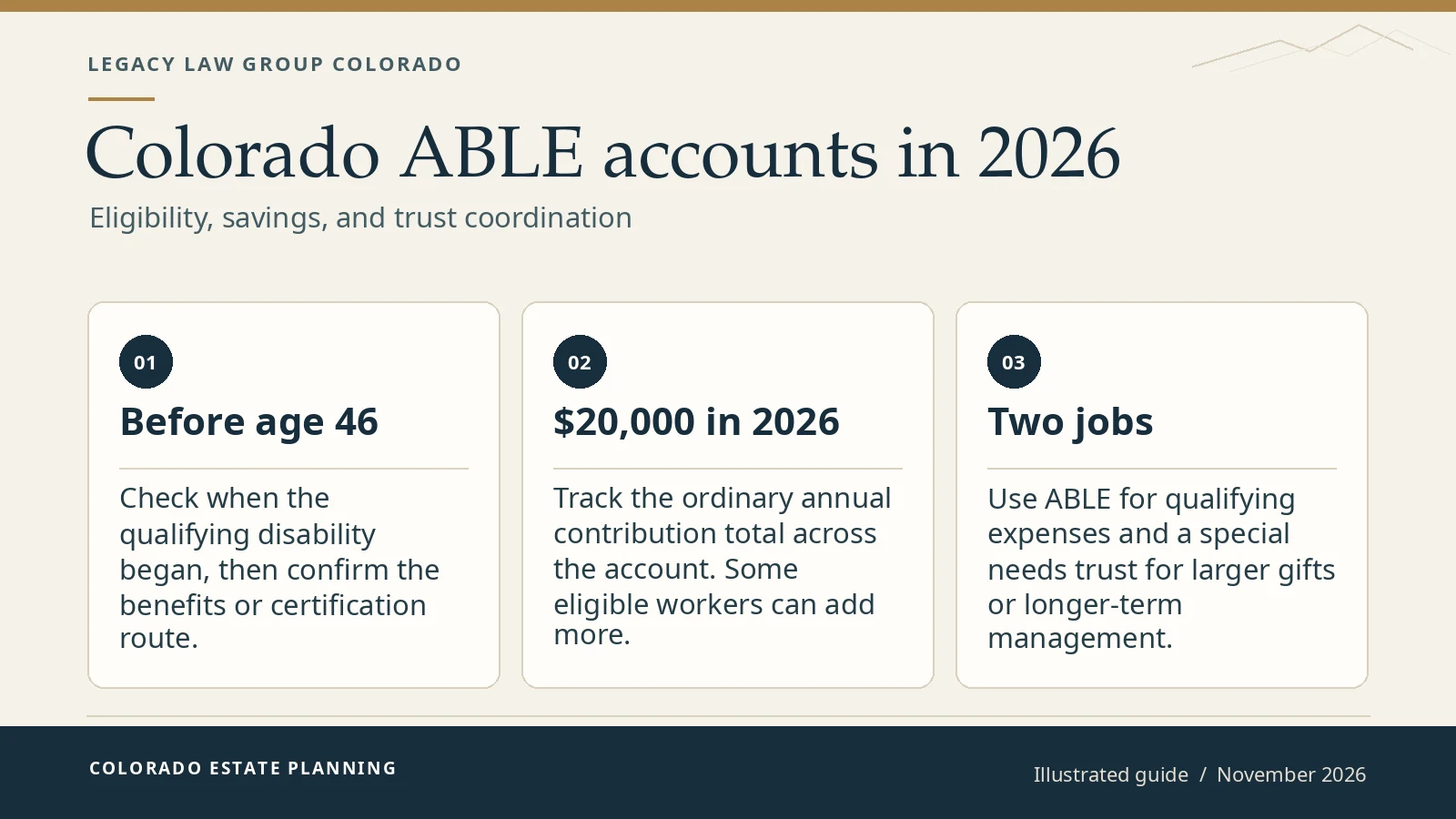
$12,000 contributed (60%); $8,000 remains (40%). This example excludes extra contributions that eligible working beneficiaries may be allowed to make.
Related video
This recorded webinar from the ABLE National Resource Center explains the federal expansion. See the Colorado plan and SSI sources in this article for program-specific details.
Watch on YouTube: 2026: The Year of New ABLE Opportunities.
Frequently asked questions
Can I open an account if I am older than 46?
Yes, if the qualifying disability began before your 46th birthday and you meet the other eligibility requirements. Your current age is not the cutoff.
Is the $20,000 limit per contributor?
No. It is the standard 2026 aggregate annual limit across ordinary contributions. Some eligible workers can make a separate additional contribution.
Will an ABLE account replace a special needs trust?
It can handle some expenses, but it has annual funding limits and different control and remainder rules. Review larger inheritances and long-term oversight separately.
Sources and next steps
- Colorado ABLE: Eligibility
- IRS: ABLE account eligibility, taxes, and 2026 contribution limits
- Social Security: ABLE and SSI rules
- Social Security: SSI treatment of trust disbursements
- Colorado ABLE: Plan disclosure, January 2026 supplement
- ABLE National Resource Center: 2026 webinar, slides and transcript
Sources checked November 15, 2026. This article provides general information about Colorado planning. The details of your documents and circumstances matter.
For help reviewing your estate plan, contact Legacy Law Group Colorado.