Date:
November 15, 2026
Author:
/
Summary and contents
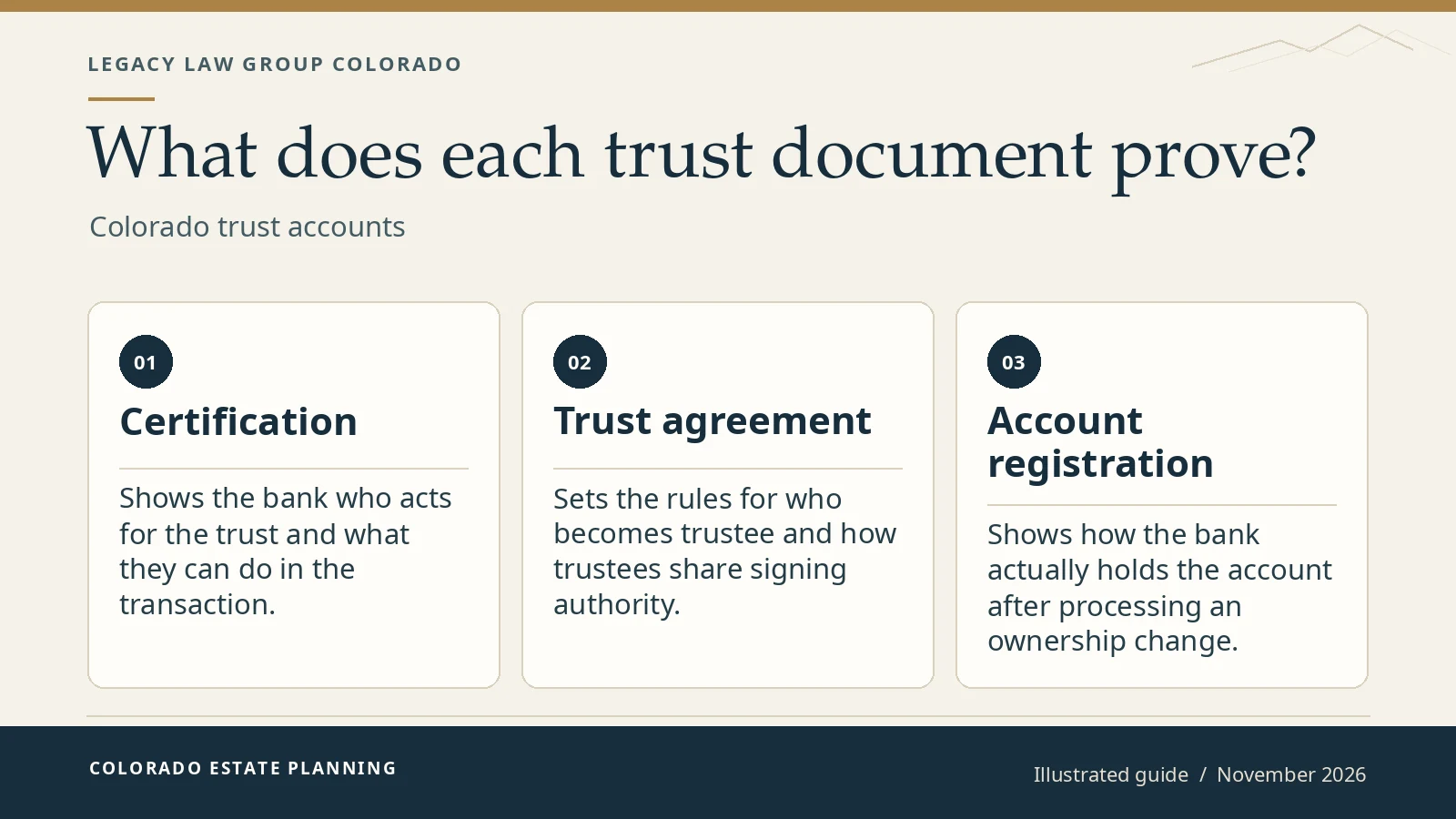
A Colorado certification of trust summarizes the trust’s existence, who is acting as trustee, and what the trustee may do in a particular transaction. It can omit who inherits and on what terms. A bank may still need relevant excerpts or other documentation. The certification shows authority; a separate account or title change is what puts an asset into the trust.
- What a Colorado certification of trust tells the bank
- What if the bank asks to see more?
- Check who can sign before you certify anything
- Confirm the account was actually transferred
- Make one folder for the transaction
- Comparison at a glance
- Visual guide
- Related video
- Frequently asked questions
- Is a certificate of trust the same as a certification of trust?
- Do I have to list all trust beneficiaries?
- When should I get an updated certification?
- Sources and next steps
You’re opening a trust account or helping a parent update one, and the bank asks to see the trust. The full agreement may include private family and inheritance details. A Colorado certification of trust is often the right place to start. What you send next depends on the transaction and what the bank still needs to verify.
What a Colorado certification of trust tells the bank
Under C.R.S. § 15-5-1013, a trustee may give a certification to someone other than a beneficiary instead of providing the entire trust agreement. The certification helps the recipient check the facts that matter to the transaction without turning over the family’s distribution instructions.
The certification identifies the trust and its execution date, who created it (the settlor), the current trustee and address, the trustee’s powers for the pending transaction, whether the trust can be revoked and by whom, how co-trustees may act, and the name in which trust property can be titled. It must also confirm there has been no revocation or change that makes those statements inaccurate.
An amendment does not automatically make every old certification unusable. The key question is whether the amendment makes any representation in it inaccurate. Check it against the signed agreement and any changes before sending it.
What if the bank asks to see more?
Ask the bank to identify the transaction and the specific information it still needs. Under § 15-5-1013, a recipient may ask for the parts of the original trust and later amendments that identify the trustee and show the power to complete the transaction.
Colorado’s banking statute, C.R.S. § 11-105-111, also addresses certificates of trust. It specifies an acknowledged affidavit or a written statement expressly made under penalty of perjury, and it allows a bank to request additional information, including signatures from all trustees. The statute does not require a bank to enter a transaction when a trustee declines to give it the trust agreement. A separate provision in the Trust Code addresses demands a court determines were made in bad faith. Whether it applies depends on the circumstances.
Try this: “I have a current certification of trust. Can you tell me which appointment or signing power you need to confirm, which pages you require, and how I can submit them securely?” If the request remains broad, have a Colorado trust attorney review it before providing the entire agreement or signing new obligations.
Check who can sign before you certify anything
A trustee may sign or authenticate a certification under the Trust Code. That does not mean that trustee can act alone on the bank account. The trust may require two trustees to sign for a particular transaction. The bank may also have its own documentation requirements.
If you are a successor trustee, confirm when the change takes effect and what proves it. A trust may require evidence of death, resignation, or incapacity and may specify how the successor accepts the role. The right packet depends on the event and the agreement. A bank may ask for documents supporting the change and an updated certification showing who is now acting.
A trustee and a financial agent under a power of attorney have different roles. If a parent’s account is in their own name, first confirm whether you need to act as agent rather than trustee. Legacy’s guide to understanding Colorado powers of attorney explains that separate process.
Confirm the account was actually transferred
Suppose you give your bank a signed certification on Tuesday. On Friday, the account statement still lists your individual name as owner. Ask whether the bank has completed the ownership change. Sending the certification lets the reviewer verify who can act for the trust; the bank’s records show whether the account is held in the trust’s name.
Ask for written confirmation of the new registration and compare it with the name your attorney says to use. If you are opening a new account, confirm its title before moving funds. Tax treatment, account contracts, and beneficiary rules may affect whether an account should be retitled at all. Review those questions before acting, especially for retirement accounts. Legacy’s Colorado trust funding guide explains how account ownership fits into the rest of your plan.
Make one folder for the transaction
- Keep the signed trust and amendments together in a private location.
- Prepare the current certification and evidence of any trustee change.
- Get the bank’s requirements in writing, including signature and identification checks.
- Share the requested documents securely and keep a record of what you provided.
- Save the bank’s written confirmation of trustee authority or the completed ownership change, whichever you requested.
If the bank’s records and the trust disagree, bring both to a Colorado trust attorney so the correction addresses the actual problem.
Comparison at a glance
| Document or record | What it establishes | What to check next |
|---|---|---|
| Certification of trust | Key facts about the trust and the acting trustee | Does it match the latest agreement and the requested transaction? |
| Trust and amendments | Who can act, on what terms, and with which powers | Have any appointment or signing rules changed? |
| Bank account registration | How the institution records ownership | Is the account titled in the form your plan calls for? |
Visual guide
Related video
This related Legacy Law Group Colorado video provides background. Use the written guide for the specific procedures and rules discussed here.
Watch on YouTube: Avoiding Probate in Colorado: Why You Need a Trust.
Frequently asked questions
Is a certificate of trust the same as a certification of trust?
People often use both terms for a summary provided to a bank or other institution. Colorado’s Trust Code says “certification of trust” and its banking statute says “certificate of trust.” Check the requirements for your transaction.
Do I have to list all trust beneficiaries?
A certification under § 15-5-1013 can omit the terms that say who receives property and on what conditions. A specific institution or transaction may call for supporting information separately.
When should I get an updated certification?
Review it whenever a change affects what it says, such as a trustee transition, revised co-trustee powers, or an event that changes whether the trust is revocable.
Sources and next steps
- Colorado Uniform Trust Code, C.R.S. § 15-5-1013
- Colorado Banking Code, C.R.S. § 11-105-111
- Colorado General Assembly: official statutes access
Sources checked November 15, 2026. This article provides general information about Colorado planning. The details of your documents and circumstances matter.
For help reviewing your estate plan, contact Legacy Law Group Colorado.