


Date:
October 15, 2026
Author:
/
Prepared October 15, 2026. General information for Colorado families; individual legal and tax advice depends on your circumstances.
You want an inheritance to make your loved one’s life easier: more support, more choices, and a dependable person to help. If they receive means-tested benefits, the route the inheritance takes can matter as much as the amount.
Summary and contents
A properly designed third-party special-needs trust can hold a family-funded inheritance for a loved one with disabilities while accounting for means-tested benefit rules. The trust terms, funding source, beneficiary’s control, and distributions all matter. An ordinary trust or an outright gift does not automatically preserve eligibility.
- Quick answer
- Begin with the benefits your loved one actually receives
- Keep family funds separate from beneficiary-owned funds
- Compare the inheritance routes
- Choose a trustee who can administer the plan
- Plan distributions and coordinate the wider family
- At-a-glance comparison
- Visual guide
- Related video
- Frequently asked questions
- Sources and next steps
Quick answer
A properly designed third-party special-needs trust can hold a family-funded inheritance for a loved one with disabilities while accounting for means-tested benefit rules. The trust terms, funding source, beneficiary’s control, and distributions all matter. An ordinary trust or an outright gift does not automatically preserve eligibility.
Begin with the benefits your loved one actually receives
List the programs involved before choosing a structure. Supplemental Security Income, Social Security Disability Insurance, Medicare, and Medicaid are different programs. Do not assume every disability-related benefit has the same resource test.
Collect current award letters and identify the agency or benefits professional who can explain the particular eligibility category. Record whether housing support or another program adds separate requirements.
Then describe your goals in practical terms: transportation, therapies, companionship, education, technology, or help organizing daily life. The plan should support the person’s needs and preferences rather than revolve only around an eligibility threshold.
Keep family funds separate from beneficiary-owned funds
The Social Security Administration describes a third-party trust as one funded with property belonging to someone other than the beneficiary or their spouse. Its trust guidance also examines control over trust property and distributions.
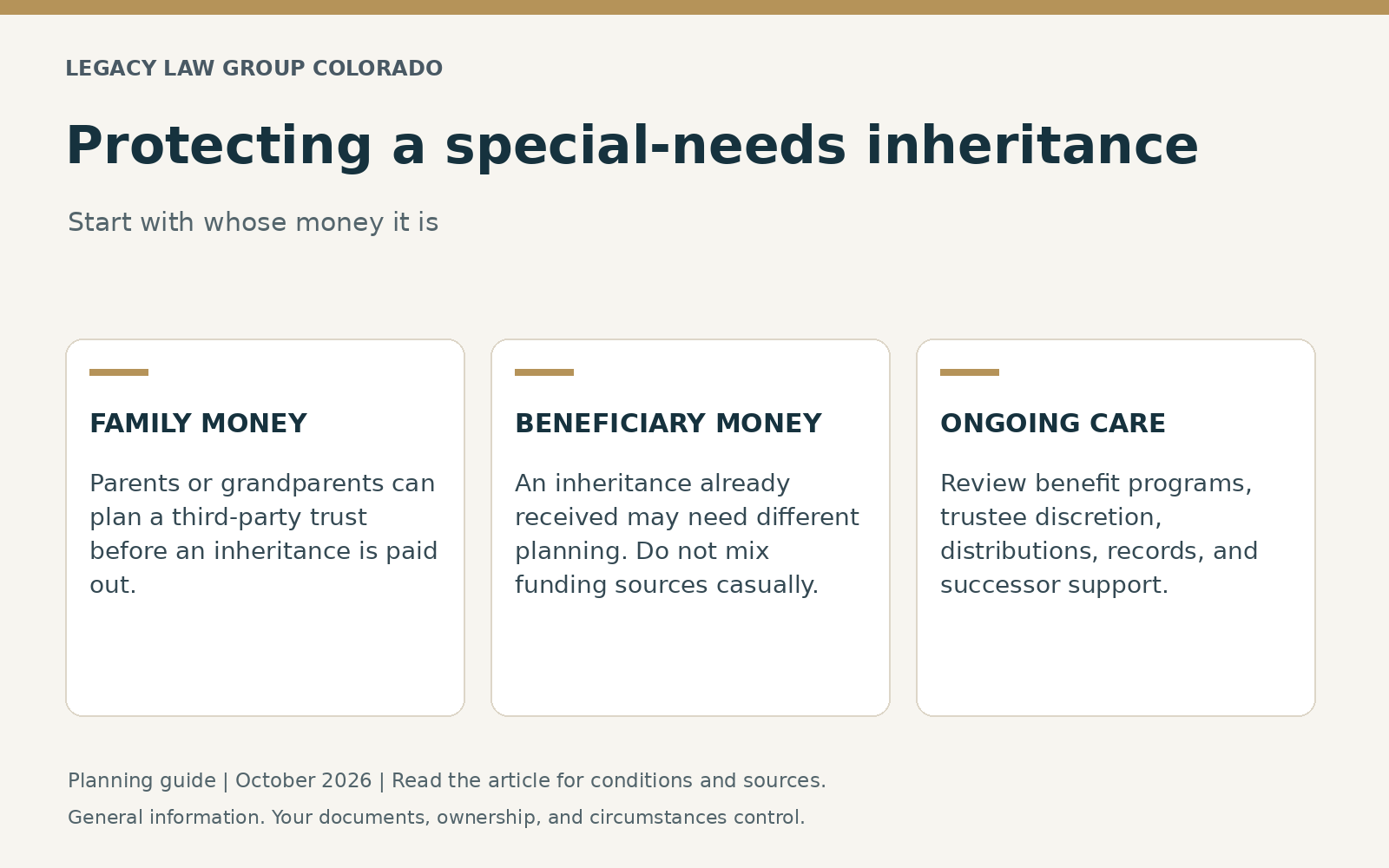
If a parent plans ahead with the parent’s own money, that is a different starting point from a beneficiary who has already inherited assets outright. Do not transfer both sources into one account and assume the same rules apply.
Before an inheritance is paid, review the will, trust, life insurance, and retirement beneficiary forms. A carefully drafted special-needs provision may not help if an unrelated account form directs the money straight to the beneficiary.
Compare the inheritance routes
An outright inheritance gives the recipient ownership and may affect means-tested benefits. A general family trust can impose some management terms but may still provide rights inconsistent with the intended benefit treatment.
A third-party special-needs trust requires deliberate drafting and administration. It is not simply an ordinary trust with the words ‘special needs’ added to the title. Have counsel review discretion, termination rights, successor trustees, and the intended remainder beneficiaries.
Beneficiary-funded disability trusts and pooled arrangements raise different issues, including possible repayment requirements. Colorado’s Health First Colorado trust policy resources address state review and administration. Do not assume rules for one category apply to every trust.
Choose a trustee who can administer the plan
A trustee needs time, records, judgment, and access to advice. Being a loving sibling is valuable, but it does not automatically prepare someone to manage investments and benefit-sensitive distributions for decades.
Discuss how requests will be evaluated, who communicates with benefits agencies, how bills will be paid, and what happens when the trustee is unavailable. Consider whether professional administration or a combination of family knowledge and professional support fits the circumstances.
A letter of intent can explain routines, relationships, preferred providers, communication needs, and hopes for the future. Keep it current and distinguish helpful personal guidance from the trust’s binding legal terms.
Plan distributions and coordinate the wider family
Ask for advice before making payments that could change benefit treatment. A payment to the beneficiary, a payment to a vendor, and payment for shelter can have different consequences. Records should show what was paid, why, and from which funds.
Tell grandparents and other intended donors how to coordinate their plans. Do not circulate sensitive trust information casually; provide the verified beneficiary designation instructions appropriate to each institution.
Legacy’s beneficiary coordination guide explains why these forms deserve attention. Contact the firm to discuss a Colorado estate plan that reflects both financial support and ongoing care.
At-a-glance comparison
| Route | Main issue to review |
|---|---|
| Outright inheritance | Ownership and possible benefit effects |
| Ordinary family trust | Beneficiary rights and distribution terms |
| Third-party special-needs trust | Family funding, discretion, and benefit coordination |
| Beneficiary-funded arrangement | Different eligibility and possible repayment rules |
Visual guide
Related video
This existing Legacy video offers background on wills and trusts. The written guide above addresses this article’s specific Colorado questions and current figures.
Watch the related video on YouTube.
Frequently asked questions
Does every disabled beneficiary need this trust?
No. Start with the person’s needs, benefits, assets, and goals. A benefits analysis should guide the structure.
Can I leave the money to a sibling to hold informally?
That gives the sibling ownership and exposes the plan to circumstances outside the beneficiary’s control. Review a formal arrangement instead.
Can an ABLE account replace a trust?
An ABLE account may complement planning, but its eligibility, contribution, and other rules differ. Compare the tools for the particular person.
Sources and next steps
- SSA: trust evaluation and third-party funding
- SSA: trusts funded with a beneficiary’s assets
- Health First Colorado trust policy and recoveries
Need help coordinating this with your own documents? Contact Legacy Law Group Colorado to discuss your estate planning questions.


