Date:
November 15, 2026
Author:
/
Summary and contents
In Colorado, a will can refer to a separate written list for specific physical belongings it does not already give away. Under C.R.S. § 15-11-513, the list must be in the will maker’s handwriting or signed by them, and it must identify the items and recipients clearly. The list cannot give away money.
- What is a personal property memorandum?
- Which belongings belong on the list?
- How to describe each gift clearly
- What if an item is gone or the recipient dies?
- How to keep one clear, current version
- Comparison at a glance
- Visual guide
- Related video
- Frequently asked questions
- Can I type a personal property memorandum in Colorado?
- Does a Colorado personal property memorandum replace my will?
- Can I add an item the will already gives away?
- Sources and next steps
You may know exactly who should get your grandmother’s ring or the tools you used with your kids. The harder question is whether the paperwork will make that choice clear to the person sorting through your belongings. A Colorado personal property memorandum can help you make those gifts specific and keep the list current.
What is a personal property memorandum?
A personal property memorandum is a written list that connects to your will and gives particular belongings to particular people. A signed list can be easier to maintain than rewriting a will every time you give a keepsake away or decide who should receive it.
Colorado Revised Statutes § 15-11-513 allows the list to be prepared before or after the will and altered later. Start by checking that the will actually refers to a separate list. If it does not, ask a Colorado wills attorney how to add or coordinate one properly.
A household inventory, a note taped to a drawer, and a video explaining a gift do different jobs. They can give helpful context, but the person handling your estate still needs to find the operative writing and know how it fits the will.
Which belongings belong on the list?
Start with things you could point to in a room: a specific piece of furniture, watch, quilt, painting, or tool collection. Your will must not already give the particular item to someone else. A different name on your list does not change a specific gift in your will.
Keep cash, bank and retirement accounts, stocks, life insurance proceeds, and real estate off the list. They require their own planning. Physical items that have separate title, ownership, or transfer rules also deserve individual review. A car, a jointly owned collection, a business-owned piece of equipment, or a regulated item may require more than a line in a memorandum.
Check ownership before writing down an item. If a trust owns the property, the trust’s terms and transfer arrangements matter. A will-based list does not, by itself, change a trust or transfer property you do not own.
How to describe each gift clearly
Imagine that the person reading the list has never seen your home. Write down the recipient’s full name and enough detail to distinguish the object from similar ones. If two relatives have the same name, add a relationship or another useful identifier. For a collection, say whether the gift includes all pieces, a particular set, or only an individual object.
Example: “The gold pocket watch engraved ‘J.R.’ on the back, kept in the blue case in my desk, to Samuel James Rivera, my nephew.” A photo can help the reader confirm which watch you mean. Keep the item and recipient identifiable on the writing itself so a missing photo does not make the gift a guessing game.
If your main goal is to share the story behind an item, put that story in a separate letter. The firm’s guide to preventing disputes over personal belongings has ideas for talking through those choices.
What if an item is gone or the recipient dies?
If you sell an item or give it away during life, update the list so no one spends time looking for it. If you replace it with a similar item, write a new description rather than assuming your original wording covers the replacement.
Colorado’s will anti-lapse provision, which can preserve certain gifts for a deceased recipient’s descendants, expressly excludes dispositions under § 15-11-513. A deceased recipient’s children are therefore not entitled to the listed item simply because that statute applies elsewhere in the will. If a planned recipient dies first, review the list and any applicable fallback instructions with counsel.
How to keep one clear, current version
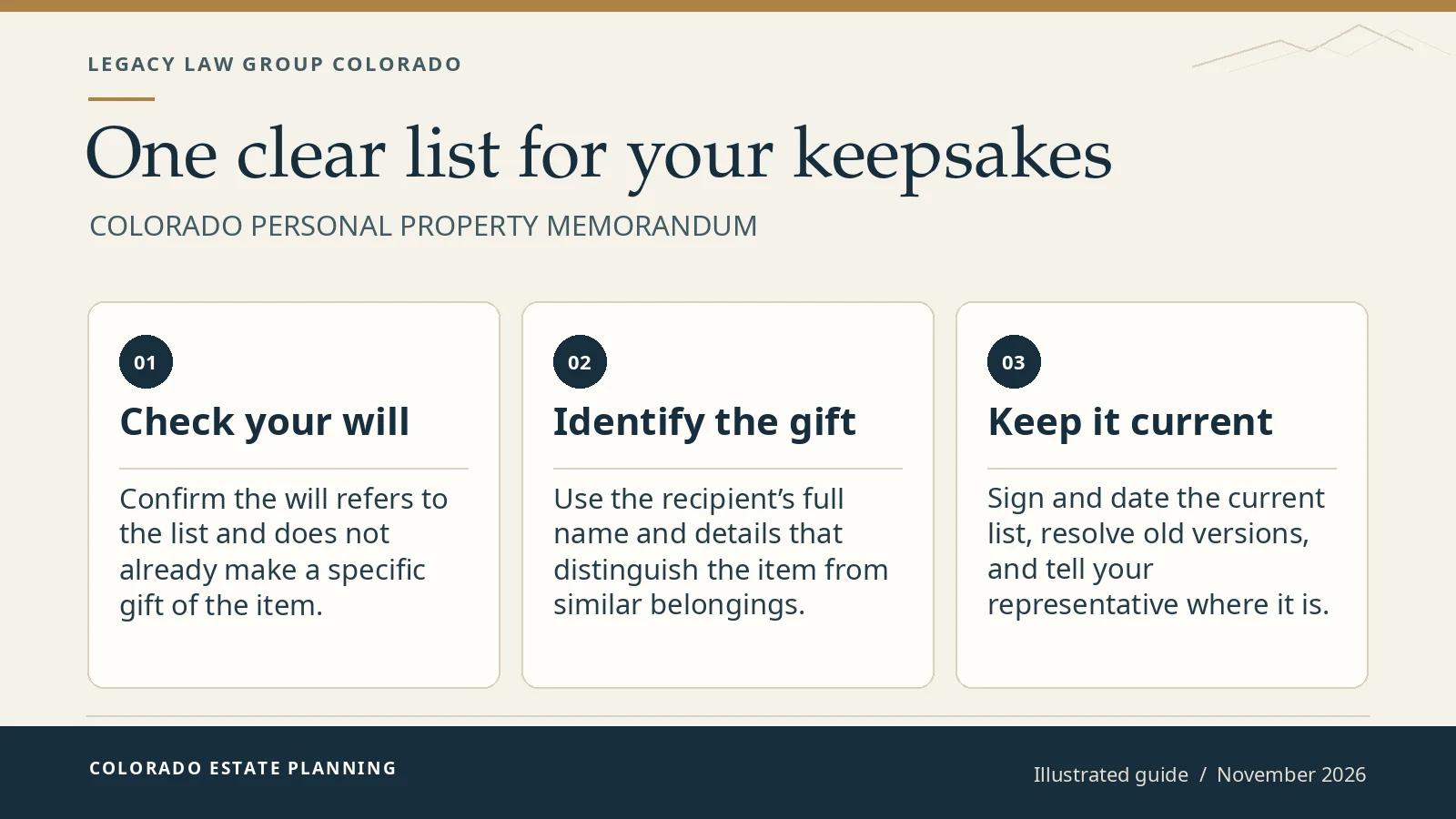
- Check the will. Find the reference to the memorandum and check for specific gifts that could conflict with the list.
- Write one complete copy. Use clear descriptions and names. Sign and date the current version. Dating is a practical way to identify the latest version; the statute describes the handwriting or signature requirement separately.
- Resolve earlier copies. Ask your attorney how to mark or handle superseded versions. Avoid leaving conflicting lists labeled as current, and tell anyone who has an old copy where to find the updated one.
- Make it findable. Store the current version with the estate planning records, and tell your personal representative who has it. Review it after a move, a sale, or the death of a recipient.
If you already have a will and an old property list, bring both to an estate plan review with Legacy Law Group Colorado. We can help you identify what belongs on the list and what should be handled elsewhere.
Comparison at a glance
| Item | Use this memorandum? | What to check |
|---|---|---|
| Grandmother’s ring | Often | Ownership, clear description, and whether the will already names a recipient. |
| Cash or bank account | No | Cash gifts belong in the appropriate estate documents; account instructions may also control. |
| House or land | No | Coordinate title, deed, will, and trust as appropriate. |
| Vehicle or business equipment | Get an individual review | Confirm who owns it and whether separate title or transfer rules apply. |
Visual guide
Related video
This related Legacy Law Group Colorado video provides background. Use the written guide for the specific procedures and rules discussed here.
Watch on YouTube: What is the difference between a will & a trust?.
Frequently asked questions
Can I type a personal property memorandum in Colorado?
Yes. Section 15-11-513 allows a writing signed by the person making the will, so it does not have to be entirely handwritten. Identify the items and recipients clearly.
Does a Colorado personal property memorandum replace my will?
No. The statute provides for a will to refer to a separate list for certain tangible property. The will and other documents handle the rest of the plan.
Can I add an item the will already gives away?
The separate-list statute does not cover an item already specifically disposed of by the will. Ask your attorney how to change the specific gift.
Sources and next steps
Sources checked November 15, 2026. This article provides general information about Colorado planning. The details of your documents and circumstances matter.
For help reviewing your estate plan, contact Legacy Law Group Colorado.