Date:
December 29, 2025
Author:
Anastasia Fainberg
/
Founder & Managing Partner
If you own a home in Colorado, you might assume it will “naturally” pass to your spouse, your partner, or your kids someday. I hear this every week, from clients in Denver, Highlands Ranch, Aurora, Lakewood. Because it feels intuitive: I bought it, I paid the mortgage, my family knows what I want. And you’re not alone… roughly two out of three Colorado households own the home they live in, so this isn’t a niche issue. It touches most families in our state.
But Colorado law doesn’t work on assumptions. Even a fully paid-off home, no debt, no drama attached, can be frozen, delayed, or controlled by the probate court if the legal paperwork isn’t aligned. And when real estate is involved, probate becomes one of the most time-consuming and emotionally draining parts of settling an estate.
As an estate planning attorney, I’m writing this because your home is more than a structure. It’s where your children grew up, where the holiday dinners happened, where your memories live. You deserve clarity about how Colorado probate really treats your property, and what you can do to protect your family from unnecessary court involvement.
By the end of this article, you’ll understand the difference between probate, beneficiary deeds, and living trusts, and you’ll know exactly what steps help keep your home, and your family, out of court as part of thoughtful estate planning.
Why This Problem Exists in Colorado Estate Planning for Homeowners
Homeowners in Colorado often misunderstand how real estate transfers after death.
The law requires court oversight unless the property is titled and planned correctly. A home cannot be distributed informally, not even if “everyone agrees.” Probate in Colorado is public, slow, and requires an inventory of your assets. Creditors, disputes, or unclear titles can delay transfer for months. And real estate almost always triggers probate when there isn’t a trust in place.
Pro Tip: If you’ve ever searched “Denver will attorney” or typed estate planning attorney near me into Google, you’ve probably already sensed that your deed and your estate plan need to match.
Working with a Colorado-based estate planning lawyer who understands Denver’s housing market and probate process can make all the difference.
Case Study: Maria (Denver Widow Whose Home Was Delayed 11 Months)
Maria lived in a small brick bungalow in Congress Park. She lost her husband unexpectedly and assumed the home, titled jointly, would transfer to her adult children when she passed.
Her will stated exactly that. A will attorney had helped her many years earlier, but no one ever revisited the plan as the law, her family, and the property changed.
But wills don’t avoid probate in Colorado.
When Maria died, her kids were shocked to discover the home required a full probate proceeding. The court demanded an appraisal. A creditor filed a claim. One sibling questioned the division. What should have taken weeks dragged on for 11 months. The home sat empty, uninsured for a period, and emotionally heavy for everyone involved.
Nothing about their grief was made easier by court timelines.
It wasn’t a lack of love or communication, the structure just wasn’t set up to bypass probate through trust-based estate planning services.
Plain-English Breakdown for Colorado Homeowners: How an Estate Planning Attorney Uses Probate, Beneficiary Deeds, and Living Trusts
1. Probate (Default if You Only Have a Will or No Plan)
Probate is the court process required to transfer real estate after death. It’s public, slow, and can cost thousands in legal fees and court filings. If your home is in your name when you pass, probate is almost always required.
If you’re searching for a trust and estate attorney because you’ve heard “probate is a hassle,” you’re not wrong, especially when real estate is involved.
2. Beneficiary (Transfer-on-Death) Deed
This deed names who inherits your home upon death. It can avoid probate if executed and recorded correctly. However, it doesn’t protect against incapacity, disputes, debt issues, or timing problems.
Many people try to handle this themselves without talking to a lawyer for wills and trusts, and small mistakes can undo what they were trying to accomplish.
3. Revocable Living Trust (Most Protective)
You retitle the home into your trust while you’re alive. You stay in complete control. When you pass, the home transfers privately to your beneficiaries, no court. It also protects during incapacity, which is something a TOD deed cannot do.
This is where working with a living trust attorney comes in. The trust is only effective for avoiding probate if your home is properly titled into it.
Side-by-Side Comparison
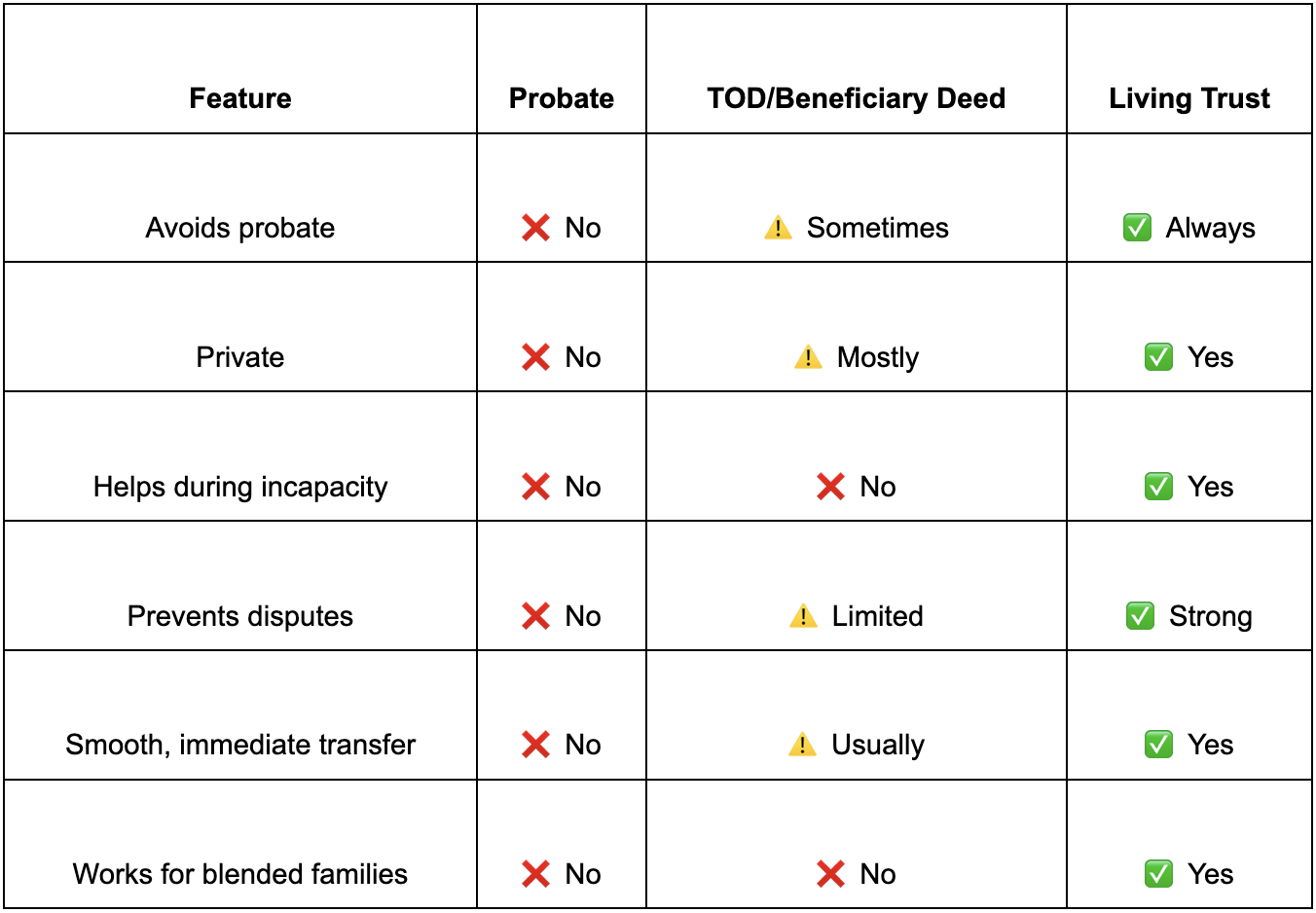
For many Denver homeowners, a revocable living trust is the backbone of smart estate planning in Colorado.
Emotional Reflection – What’s Really at Stake
Your home is more than an asset on a spreadsheet. Colorado families tell me this all the time: “This house is our story.” It’s where lives were built. It’s where grandparents rocked babies to sleep. It’s where people returned after hard days.
The idea of a court stepping in, freezing the property, deciding timelines, reviewing documents, feels deeply unsettling for most families.
I understand that feeling. I’m a mom too. I’ve thought about these things for my own family. When I sit down with someone who took the time to sit down and search for an estate attorney in Denver because they’re worried about their house, what they’re really saying is, “I just want my family to be okay.”
Planning isn’t about legal sophistication. It’s about preserving the dignity and continuity of your family’s life.
Legal Analysis – Key Colorado Concepts Every Homeowner Should Know
- Title Controls, Not Intent
Colorado courts rely on the deed, not your verbal wishes or family expectations. - Wills Do NOT Avoid Probate
This is the biggest misconception I correct in consultations. A will still requires court involvement to transfer real estate. - Joint Tenancy Isn’t Bulletproof
Surviving joint tenants inherit the property, but when the last one dies, probate is triggered again. - Beneficiary Deeds Must Be Precise
One mistake in wording or recording can invalidate the transfer. - Trust Funding Is Essential
A trust only avoids probate if you actually retitle the property into it. - Multiple Properties = Multiple Risk Points
If you own Colorado and out-of-state real estate, you may trigger multiple probates without a trust.
If you’ve ever wondered if you need a trust and estate attorney to “fix” your deed, the honest answer is: if you want clean, efficient transfer of your home, professional guidance is almost always worth it.
The Reality: Colorado Estate Planning vs. Letting the State Decide
If you don’t make a plan, Colorado makes one for you.
Without a plan:
- The court decides who manages your estate.
- The process is public.
- The home may be frozen for months.
- Siblings can disagree.
- A sale may be forced.
With a custom estate plan:
- You choose the decision-maker.
- You control how and when the home is transferred.
- Your family stays out of court.
- Your wishes remain private.
For many people, that’s the moment they realize they don’t just need “some documents”, they need a relationship with an estate planning attorney who can help them structure their home and other assets for real life, not just paper.
In short: Choosing your plan keeps your home in your family’s hands, not the court’s.
Common Misconceptions
- Myth #1: “My will protects the house.”
In Colorado, a will guarantees probate. It does not keep the home out of court. - Myth #2: “My kids automatically inherit my real estate.”
Not legally. The court must validate the transfer unless the property avoids probate. - Myth #3: “Joint tenancy solves everything.”
It only delays probate until the last joint tenant passes. It doesn’t help children or protect during incapacity. - Myth #4: “We don’t have enough equity to worry.”
Your home doesn’t need to be high-value to trigger probate. Any Colorado real estate does. - Myth #5: “The bank will let my kids handle it.”
Banks require legal authority, usually provided only by probate or trust documentation.
I hear versions of these myths constantly, often from people who just spent weeks Googling estate planning, trusts or any other search they can think of, trying to sort out what’s real.
Why This Really Matters
Your home carries the story of your life. It represents security, identity, belonging. Protecting it isn’t just about the legal transfer, it’s about preserving the emotional heartbeat of your family.
As I often tell families, it’s not about money. It’s about the people you love.
That’s why working with a local Denver estate planning attorney isn’t about being “fancy.” It’s about making sure what you’ve built actually ends up where you intend.
How to Start (Simple Steps)
- Review your current deed.
Check how it’s titled and whether it reflects your wishes. - Confirm all beneficiary designations.
Especially if you’ve refinanced or changed ownership. - Evaluate probate exposure.
Real estate + will = probate. Every time. - Learn whether a living trust makes sense.
Most Colorado homeowners benefit from the privacy and protection. This is where estate planning services from a trusted firm can walk you through options. - Update titling if needed.
Make sure your trust, or chosen transfer strategy, is properly implemented. - Join our Client Care Program to ensure your plan evolves as your life changes. Your relationship with your estate attorney shouldn’t end when you sign documents.
FAQs: Colorado Estate Planning, Probate, and Protecting Your Home
1. Does a Transfer-on-Death (TOD) deed avoid probate in Colorado?
Yes, when drafted and recorded correctly. But it doesn’t help during incapacity or prevent disputes among heirs. For many families, a trust designed with a trust and estate attorney offers more protection.
2. How long does probate take when real estate is involved?
In Colorado, most probate cases take 6–12 months, longer if there are disputes or unclear titles. A Denver-based estate planning attorney can often estimate realistic timelines after reviewing your situation.
3. What happens if there’s still a mortgage?
Your beneficiaries can usually assume or refinance the loan, but probate will delay that process unless the home is in a trust. A trust lawyer can help structure things so your family isn’t stuck waiting on court decisions.
4. Will property taxes change after death?
They can. Transfers outside probate are often simpler to manage and plan for as part of comprehensive estate planning.
5. What if siblings disagree about selling the home?
Without clear instructions in a trust, disagreements often lead to delays, mediation, or even court intervention. A trust and estate attorney can help you put guardrails in place now.
6. What about out-of-state property?
You may trigger multiple probates. A trust can consolidate all real estate into one plan, which is a common strategy when you work with a trust lawyer in Colorado or a multi-state-focused estate planning lawyer.
7. Does a will help avoid disputes?
Not reliably. Probate invites oversight and opportunities for disagreement. Clear trust language often does more to prevent conflict.
8. Does a trust mean I lose control?
Not at all. A revocable living trust leaves you fully in charge while you're alive. A living trust attorney will structure it so you stay the primary decision-maker.
9. Can step-children inherit through a trust?
Absolutely, trusts are the best tool for blended family planning. This is one of the most common reasons people look for a trust and estate attorney.
10. Is a trust expensive?
It’s usually far less costly than probate. Clients are often surprised by how accessible trust-based planning is, especially in Denver, where working with an estate planning attorney can prevent tens of thousands of dollars in court and conflict costs.
Closing Reflection
Your home deserves to stay in your family’s hands, not the court’s. A thoughtful, Colorado-specific plan protects the memories, the value, and the people you love most.
Don’t leave your family’s future to chance. Schedule your consultation with Legacy Law Group, today and take the first step toward peace of mind with a trusted estate planning attorney at your side.